
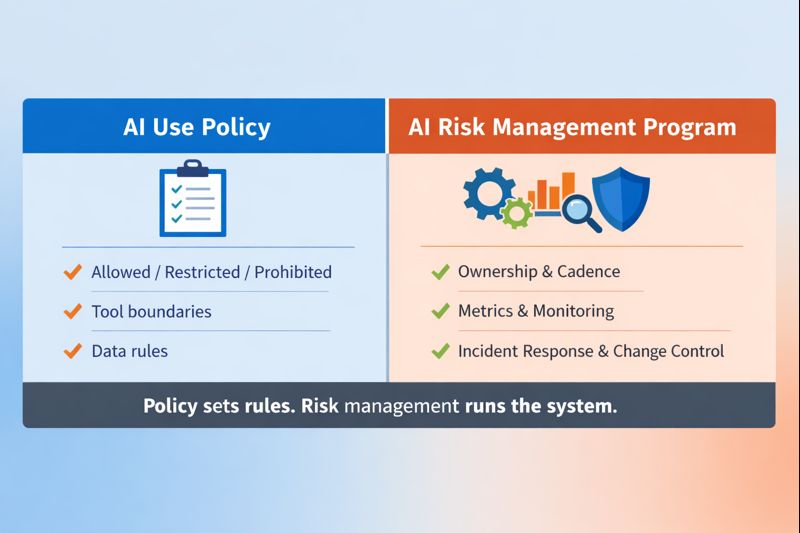

Most organizations are at the same stage right now: teams are using AI daily, leadership wants speed, and someone says, “Let’s publish an AI policy so we’re covered.”
An AI use policy is a necessary start. But it’s not a responsible AI program. Data doesn’t lie: if you only ship rules, you still won’t have clear ownership, repeatable controls, or a way to detect and respond when things go wrong.
This post clarifies the difference—and gives you a minimum-viable path from “ad hoc AI usage” to defensible adoption.
What an AI Use Policy Is (and Why You Need One)
Definition: An AI use policy is a set of acceptable-use boundaries for tools, data, and outputs. It defines what people can do with AI in your organization—and what they can’t.
At a minimum, an AI governance policy typically answers:
- Which tools are permitted (and which are prohibited)
- What data may be used (and what data is off-limits)
- How outputs may be used (internal draft vs client-facing deliverable)
- What disclosures are required (if any)
- What “human-in-the-loop review” is required (if any)
What it prevents (when it’s clear and enforced):
- Obvious misuse (e.g., using AI to generate sensitive HR decisions without review)
- Inconsistent tool choice (“everyone uses a different bot”)
- Data leakage risk (pasting confidential client data into a public tool)
- Reputational drift (client-facing quality varies wildly by team)
Where it belongs: This is the intersection of HR + IT + security + legal/compliance. If your policy is owned by only one of those functions, it will be incomplete.
Minimum viable policy sections (practical, not academic)
If you’re writing or updating an AI use policy, keep it simple and enforceable:
- Purpose and scope (who/what it covers)
- Approved vs prohibited tools (and how tools get approved)
- Data handling rules (PII, client data, regulated data)
- Output usage rules (internal vs external; disclosure requirements)
- Human review expectations (by risk level)
- Security basics (access, accounts, extensions/plugins, storage)
- Recordkeeping expectations (what must be logged)
- Enforcement and escalation (what happens if it’s violated)
A tight policy creates boundaries. But boundaries alone don’t run the system.
What an AI Use Policy Does Not Do
A policy is a document. Responsible AI requires an operating model. Let’s drill down on the gaps leaders often miss:
- It doesn’t assign end-to-end accountability.
A policy may say “don’t do X,” but it rarely names who owns AI outcomes across functions and use cases. - It doesn’t create testing / QA requirements.
Policies rarely define required validation, accuracy checks, bias checks, or review steps—especially when tools change. - It doesn’t define monitoring, drift, or quality triggers.
If output quality degrades, prompts change, a model update happens, or error rates spike—who notices, and what is the trigger to act? - It doesn’t define incident response.
When AI outputs cause harm (data exposure, client complaint, regulatory concern), a policy usually doesn’t provide a playbook: containment, investigation, communication, and corrective actions. - It doesn’t handle vendor change management.
AI vendors ship changes constantly. A policy doesn’t typically define the control points for new features, model upgrades, new data usage terms, or new integrations. - It doesn’t create a system inventory or documentation trail.
Without a simple inventory, you can’t answer basic questions: Which teams use which AI tools for what purpose? Where is data going? Who approved it?
A short scenario (where “policy-only” breaks)
Marketing uses AI to draft client-facing copy. Finance uses a different tool for internal summaries. Someone copies sensitive client data into the wrong place to “get a better answer.” Now leadership is asking: Who approved the tool? Who owns the decision? What do we tell the client? Was anything logged?
A policy helps you say, “That wasn’t allowed.”
A risk management program helps you ensure it’s less likely to happen, and that when it does, you can respond fast, learn, and prevent recurrence.
AI Risk Management = the Operating Model (Not Just Rules)
Definition: An AI risk management program is the operating model that makes responsible AI real:
- Roles (owners, approvers, reviewers)
- Lifecycle controls (intake → assess → implement → monitor → change)
- Metrics (quality, risk, adoption, operational health)
- Monitoring (drift, incidents, complaints, usage anomalies)
- Continuous improvement (lessons learned → control updates)
Think of it this way:
Policy is one control. Risk management is the control system.
If you want a standards-based reference for structure, the NIST AI RMF is a common anchor—but it should stay a reference point, not the whole conversation.
The Simple Comparison (Required Table)
| Category | AI Use Policy | AI Risk Management Program |
|---|---|---|
| Purpose | Define what’s allowed / prohibited | Reduce AI risk across the lifecycle while enabling adoption |
| Owner | Typically HR/Legal/IT (document owner) | Cross-functional governance owner + accountable business owners |
| Frequency | Periodic updates (quarterly/annual) | Ongoing AI operating cadence (monthly/quarterly) |
| Scope | Tool rules, data boundaries, output usage | Intake, assessment, controls, monitoring, incident response, change control |
| Key artifacts | Policy text, training acknowledgement | Inventory, risk tiering, review checklists, metrics dashboard, incident playbook, vendor triggers |
| Success measure | “We have a policy” / completion of training | Fewer incidents, faster approvals, measurable quality, defensible decision trail |
Minimum Viable Governance (What to Implement First)
If you want AI adoption that scales without chaos, start with “minimum viable governance.” Let’s measure twice, cut once—this list is designed to be implementable in weeks, not quarters:
- Approved tools list + prohibited tools list (and how exceptions get reviewed)
- Data handling rules (PII/client data boundaries; what never goes into public tools)
- Human review requirements by risk level (especially for client-facing outputs)
- Logging / documentation basics (what was used, by whom, for what, and where outputs went)
- Ownership: name accountable owners for major AI usage categories (marketing content, finance analysis, HR support, customer support, etc.)
- Use case inventory (a simple spreadsheet is fine: tool, purpose, data types, owner, risk tier)
- Vendor review triggers (new tool, new features, model changes, new integrations, data policy changes)
- Basic metrics (quality + risk + adoption): errors/complaints, review rates, incident count, time-to-approve new use cases
- Incident response path (who to call, what to do first, how to document)
- Monthly/quarterly governance cadence (a short standing meeting beats a long annual review)
That’s enough to create AI oversight and accountability without building a bureaucracy.
When You Need More Than “Minimum Viable”
Minimum viable is the baseline. You need stronger responsible AI controls and AI risk controls when any of these are true:
- Client-facing outputs (anything a customer can see or rely on)
- Sensitive data involved (PII, client confidential data, regulated data, security data)
- High-stakes decisions (money, employment, eligibility, compliance determinations)
- Frequent model/tool changes or third-party vendors (rapid change increases operational risk)
These are the conditions where policy-only approaches fail fastest.
How FCG Helps with AI Use Policy
Most leadership teams don’t need another PDF. They need a system that runs.
Fletter Consulting Group (FCG) helps organizations operationalize responsible AI by:
- Designing the AI use policy so it’s clear, enforceable, and aligned with real workflows
- Building the operating model: inventory, risk tiering, human-in-the-loop review, metrics, and incident response
- Running the governance cadence through a Fractional CAIO model (or setting it up and transitioning ownership once stable)
If you want the “how we deliver” view, start here: [Link Placeholder: AI Risk Management Services page]
The One-Sentence Test
If your AI policy answers “what’s allowed,” but you can’t answer “who owns it, how it’s measured, and what happens when it fails,” you don’t have responsible AI—you have rules without an operating model.
If you want AI adoption that scales without chaos, FCG can help build the operating model and run it with you.
[Link: Fractional CAIO page]
[Link: AI Risk Management Services page]